Born in the cloud
The team behind WeSafe had many years of experience in IT operations in large companies and experienced that large costs and resources were required to launch various IT projects. The traditional way of working with IT focused on the supplier's own needs and conditions - not the customer's. This became the basis for the company WeSafe: that the role of IT suppliers must change by reallocating time and finances from operations to innovation and increased business value.

We talk to WeSafe's Peter Fritzon, Martin Liljenberg and Per Liljenberg about the challenges and benefits of being 'born in the cloud'.
How did you experience the costs of traditional IT and how this affected customers?
Peter Fritzon, CEO of WeSafe
When we started WeSafe, the picture was very different from today. IT was rarely linked to other parts of the organization and the focus was not on function and business benefits. Back then, technology was at the center and projects were often run entirely by the IT department. The technology solutions that suppliers provided to customers were the same, regardless of what the customers' organization looked like and what their needs were. The focus was therefore far from business values and became a question of hygiene factors.
We were often surprised that companies were not fully aware of their solutions. It was generally accepted that people didn't really "understand" what different invoices were about. It seemed very strange to us that customers were paying quite a lot of money for something they barely knew what it was.
Per Liljenberg, Cloud Specialist at WeSafe, agrees and continues:
In the past, it has often been a matter of self-developed solutions with many customizations where the wrong decision could be very costly. Or systems were chosen based on which IT platform was already used in the business and what was easy for IT to maintain on existing servers. Not based on what the business actually needed. This has largely been due to a lack of knowledge about the possibilities of the technology and, for fear of making the wrong decision, the issue has instead been left to the IT department.
How did you want to stand out as an IT provider?
Martin Liljenberg, Technology and Development Manager at WeSafe:
Previously, the focus was on operations, security and networks - things that are already built into most major cloud services today. We saw an opportunity to manage such functions via large-scale operations and instead focus our role on assisting with knowledge and skills to add value to business development. Our ambition was to offer IT in a new way, focusing on business benefits instead of technology. Initially, by replacing and developing basic functions that previously resided on the customer's servers - email, file sharing and so on - and moving them to the cloud. When we moved the basic functions, we were able to focus more on developing and streamlining processes and flows in the business by offering customers migration from their own server solution to a cloud platform.
Per Liljenberg adds:
Many IT providers have not been sufficiently competitive. For example, in the past, if you were a local player offering hosting services in your geographical area, local customers would come to you. As a result, they have not had to focus as much on customer needs and business benefits as in many other industries.
We saw an opportunity to differentiate ourselves from the crowd and that has been our focus from day one. Both in terms of what services we offer and how we want to deliver them. Among other things, we noticed that many IT suppliers did not specify their invoices other than by writing, for example, "consulting services". This made it impossible for the customer to know what the supplier had actually done. Therefore, we chose instead to be very clear in specifying exactly what kind of work we had done.
What has been the main challenge along the way?
Martin Liljenberg, again:
The biggest initial obstacle was the skepticism we faced from customers. They, in turn, were influenced by the incumbent industry that believed that the cloud was not "secure enough" and that the only thing that really counted was traditional IT - without really being able to back up these claims with anything concrete. All cloud-related services were portrayed as more or less suspect - unless they added features that fit in with what the established vendors wanted to sell, in which case they were often fine.
However, our position has always been that with the pace of change in IT, you cannot rely on proprietary IT for general functions in the long term. It will hinder the company's ability to develop. Proprietary solutions will never be able to keep up with the development of the major cloud services.
What has been the advantage of being born in the cloud as an IT provider?
Peter Fritzon concludes:
For us, adapting to new technologies has been easy from the start because we don't have anything 'old' to take into account. Everything is slower if the business has focused on a specific business for many years and then suddenly has to embrace a new one. It is possible that we would have expanded faster if we had initially offered a mix of traditional solutions and cloud services. But we chose to go all in on the cloud and it has paid off in the long run.
For traditional businesses, it also becomes a question of investing in employees with new knowledge and skills - something that is not always welcomed with open arms by existing staff. No one who works with us has an "older" view of IT or outdated knowledge and skills that they want to hold on to - the old way of thinking has never even existed in our business.
If we find new solutions and services that we believe will benefit our customer, it is our mission to offer them to our customers - no matter how inconvenient it may be. By working with this forward-looking attitude, it is not the industry that drives us to change, but we are involved in changing the industry. Many traditional IT providers have been more or less forced to deliver cloud services, while for us it has been the very origin of how we want to work.
Get in touch with us, and together we will ensure that you do not become the one who is satisfied with "IT should just work", but become one of the successful companies that see IT as a core process that creates value with the help of digital technology. Contact us!
Inspiration and knowledge straight to your inbox
Sign up for our monthly inspirational newsletter that gives you tips, insights and advice on new ways of working, processes and security related to Microsoft 365, Azure and various tools in Microsoft's cloud platform.

Upheads Evergreen
We take care of your entire IT environment.
From productivity and efficiency, to updates, security and compliance.
-
A warm welcome to Borna and Rebecka!
We've added to our team and are happy to welcome two new colleagues! Borna has started as a Cloud Advisor...
→ Read more -
IT Strategy – How to Set the Right Priorities
IT is an important part of how companies grow today. Despite this, IT and business operations are still planned...
→ Read more -
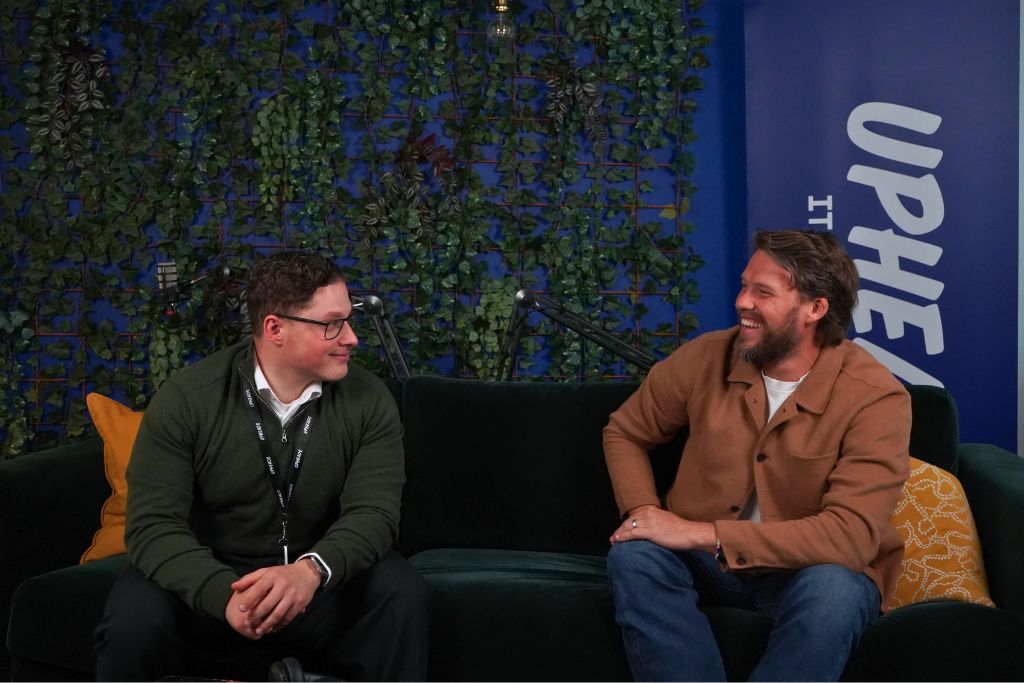
Digital Sofa – Passkeys
In this episode of Digitala Soffan, Samuel and Kevin talk about passkeys—a login method that ...
→ Read more