You're using AI—but is it actually doing the work?
Many companies have already started using AI. We summarize meetings, analyze documents, search for information, and get help writing emails and presentations.
It saves time and helps employees in their day-to-day work. But more often than not, that’s exactly what it is— a tool that helps a person do their job.
The next major opportunity will arise when AI becomes an integral part of the work process itself.
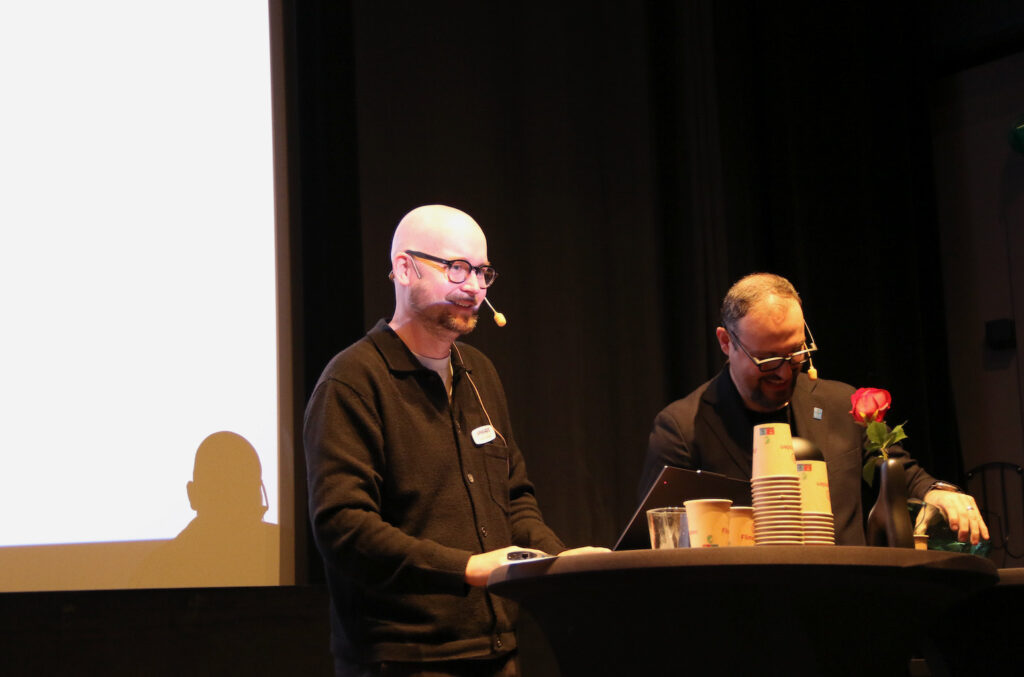
Patrik and Saeid are happy to help you with AI that actually makes a difference in your work
Not just by answering questions, but by understanding information from multiple sources, analyzing a situation, recommending the next steps, and—when appropriate—taking the work forward.
From AI that helps, to AI that actually contributes to the work.
AI can do more than just summarize and search
Imagine a new customer inquiry coming in. An AI assistant can help the salesperson summarize the inquiry or draft a response. But what if the AI could instead place the inquiry in a broader context?
It can understand what the customer wants, use relevant information from the CRM, previous conversations, agreements, and other authorized data sources, and analyze what is important in this particular transaction.
The result, then, need not be merely the information collected. It can be a strategically grounded analysis with recommendations on how the salesperson should proceed with the deal. That’s where AI begins to play an entirely different role in the business.
An app, an agent, or a digital assistant
The way AI interacts with employees can vary greatly. It could be a simple app where a contract is uploaded and the AI analyzes the content, identifies risks, and highlights issues that require attention.
It could be an agent who helps a salesperson analyze a business opportunity and recommend the next steps.
Or a digital assistant that works in the background, follows a process, and prepares the next step in a customer case.
So the important thing isn't the form. What mattersis the role AI plays in the work.
AI understands—automation makes things happen
There is also an important difference here between AI and traditional automation.
Creating a case when a form is submitted doesn’t necessarily require AI. Neither does transferring information from one system to another or initiating a predetermined action. Standard integrations and automations can already handle these tasks very well. AI becomes interesting when the work requires understanding and judgment.
For example, when a contract needs to be interpreted to identify risks. When information from multiple sources needs to be analyzed to recommend the next steps. Or when a customer issue must first be understood before the right process can be selected.
AI can then be responsible for interpreting , understanding, analyzing, and making recommendations.Automation and integrations can then pass on the information and carry out the predetermined steps.
It is this combination that makes it possible to tackle work processes that were previously difficult to automate. And the value isn’t just about saving time. When AI can understand and analyze information in its context, it can provide a better basis for decision-making, shorter lead times, and more consistent quality in the work. It can also reduce reliance on specific individuals by making relevant information and knowledge available within the process—regardless of who is performing the work.
What might that mean for your business?
In the sales , AI can analyze a sales opportunity based on customer history, past conversations, and other relevant information, providing the salesperson with a better foundation for the next step.
In the field of finance , AI can review documentation, understand the content, detect discrepancies, and determine what needs to be examined more closely before the case moves forward.
In HR , for example, AI can analyze information in preparation for recruitment or onboarding, identify gaps, and recommend necessary actions.
And within customer service , AI can understand what an inquiry is actually about, take the customer’s history and contracts into account, and help determine how the inquiry should be handled. In some processes, AI can be given a great deal of autonomy. In others, it is used for analysis and recommendations, while a human makes the final decision.
The point isn't to eliminate humans. The point is to let AI contribute where its capabilities actually make a difference.
When AI becomes part of the process, the demands also increase
When AI evolves from being a tool for individual employees to becoming an integral part of the organization’s work processes, a number of other factors need to fall into place.
One agent may need to use information from the CRM system. Another may need to work with documents in Microsoft 365. A third may need to combine information from multiple business systems and be able to initiate the next step.
In that case, the organization must be able to answer the following questions, among others:
- What information is AI allowed to use?
- Which systems is it allowed to access?
- What is it allowed to do on its own?
- When is human approval required?
- How can we see what an agent has done?
- How are identities and permissions managed?
- Who is responsible for the solutions once they are in operation?
This is quickly becoming a bigger issue than which AI model or assistant the company uses.
Avoid creating new AI islands
As more parts of the organization recognize the potential of AI, more ideas emerge. Sales sees one area of application. Finance sees another. HR sees a third. Customer service sees a fourth.
If each initiative is developed separately, the organization will soon end up with multiple solutions, each with its own integrations, access controls, identities, logging, and technical components. What was intended to simplify operations then risks creating yet another technical environment to manage. That is why a common foundation.
If the organization has already established a secure connection to an enterprise system, it should be possible to reuse it. The same applies to identities, permissions, logging, and other shared components.
Then the next AI solution can build on what already exists.
From AI Tools to AI Capabilities
There is a difference between using an AI tool and building the organization’s capacity to work with AI. AI assistants continue to be valuable. They help individual employees write, search, summarize, analyze, and work more efficiently.
But the next step is to also let AI contribute to work processes.
That doesn't necessarily mean that everything has to be automated all at once. Start with an area where AI's ability to understand, analyze, or make recommendations can actually change the way work is done. Once that solution is working, you’ll have a foundation to build on.
It's here Upheads ADA comes in
It is for this development that we at Upheads are building ADA.
Upheads ADAis our managed platform for AI in business. Here, AI apps , agents, background agents, and automations can work together with the business’s data, systems, and processes.
AI can be used to understand information, analyze context, and recommend next steps. Agents and automation tools can then help take the work forward where appropriate.
At the same time, there is a common technical foundation for the solutions—including integrations, identities and permissions, logging, monitoring, and controlled deployment.
This means that each new application doesn't have to be a standalone AI project. You can start with a single process, reuse what you build, and gradually integrate AI into more aspects of your business.
Where do you start?
Don't start with the question:
“What kind of AI agent should we build?”
Start with the business.
Where are there decisions that require information from multiple sources? Where do employees need to analyze large amounts of information before they can move forward? Where does a good decision rely on experience, context, and judgment? And where could better decision-making data, shorter lead times, or reduced reliance on specific individuals make a real difference?
That's where some of the most interesting possibilities with AI lie.
[ What could AI do for your business? ]
Get in touch—we’d be happy to help
Tired of filling in forms?
You can also call 040-626 75 00, Monday-Friday 08-17, or send an e-mail to kontakt@upheads.se.
Inspiration and knowledge straight to your inbox
Sign up for our monthly inspirational newsletter that gives you tips, insights and advice on new ways of working, processes and security related to Microsoft 365, Azure and various tools in Microsoft's cloud platform.